The Economy on GLP-1s: When the Consumption Engine Loses Its Appetite
68% of US GDP is us buying stuff. For the first time, a technology exists that shrinks wanting at population scale — and the earnings calls are already flinching. Here's the evidence, the price cliff, and a model you can argue with.
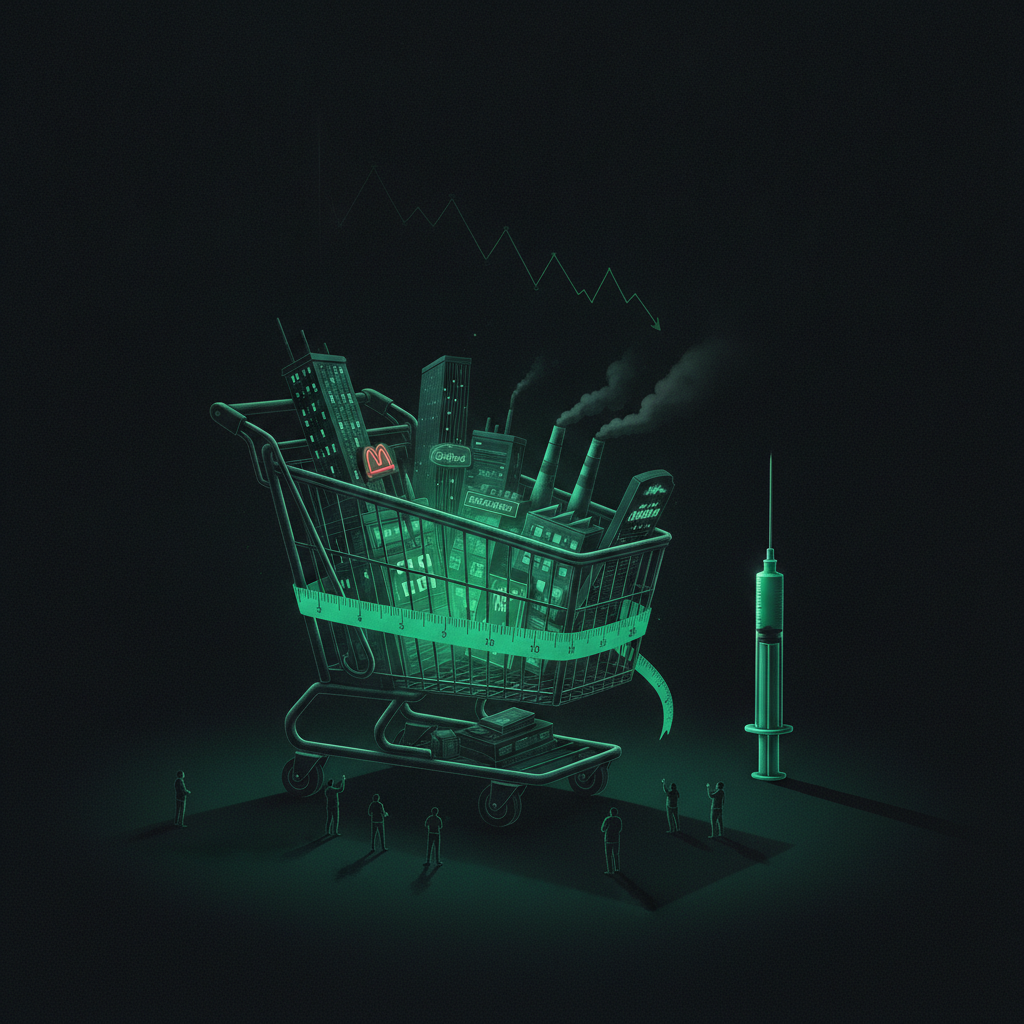
A good friend of mine sells knee replacements. Implants, the hardware, the whole orthopedic kit — he's been doing it for years, and device sales is a quota business the way software never was. Last month he told me something that stopped me cold: everyone he knows in the business is missing their numbers this year. Not one rep, not one bad territory — reps, whole companies, across the industry. And the theory his industry keeps whispering? Patients on GLP-1s are losing forty, sixty, eighty pounds… and the knee that was unbearable at 280 lbs is suddenly tolerable at 215. Surgery deferred. Quota missed. It's WILD.
Now, I checked, and the public numbers say the giants haven't cracked yet — Stryker's CEO literally called the GLP-1 scare "nonsense" and Zimmer Biomet just posted a +10.9% quarter. But a June 2026 study of tens of thousands of knee-osteoarthritis patients found long-term GLP-1 users end up with ~5% fewer total knee replacements over eight years. Both things can be true: the aggregate hasn't rolled over yet, and the guys carrying the bag are feeling the leading edge. That's usually how these stories start — anecdote first, earnings call later.
And it got me thinking about a much bigger number.
The 68% machine
Personal consumption is 68% of US GDP — about $21 trillion of a $30.8 trillion economy. Our entire system is tuned to one assumption: people want more. More food ($2.6 trillion a year of it, per USDA), more portions, more stuff. "Growth or die" isn't a slogan, it's the operating system — every quarterly target, every same-store-sales comp, every snack-aisle planogram assumes appetite is a constant.
GLP-1 drugs are the first technology in history that directly turns appetite down at population scale. Not willpower, not a fad diet with a 95% relapse rate — a weekly injection (now a daily pill) that makes roughly one in eight American adults currently taking one genuinely want less. Clinical trials measure users eating 24–35% fewer calories at a sitting. When wanting less becomes purchasable, the 68% machine has a novel problem.
It's already showing up in the data
This isn't hypothetical. The cleanest evidence: Cornell economists matched 150,000 households in Numerator's purchase panel and found that when a household starts a GLP-1, grocery spending drops 5.3% within six months — closer to 9% in higher-income households — and the cut persists past a year. It's surgically targeted at exactly what you'd guess: savory snacks −10%, cookies and baked goods −6 to −11%, fast food −8%. Walmart can see it in the register data: "less units, slightly less calories."
Then it cascades through everything downstream of appetite:
- Bariatric surgery fell more than 20% from 2022 to 2024 — under 200,000 procedures for the first time this decade. Intuitive Surgical has logged six straight quarters of bariatric declines it attributes directly to GLP-1s.
- Insulin: Novo Nordisk's insulin sales dropped 36% in Q1 2026 as diabetes care migrates to GLP-1s; TD Cowen sees Lilly's insulin franchise shrinking ~84% by 2030.
- Sleep apnea hardware: Inspire Medical cut 2025 guidance as patients try a GLP-1 before an implant — the stock lost a third of its value in a day.
- Alcohol: an NIH-backed trial found semaglutide cuts heavy-drinking days ~41%; US beverage-alcohol volumes fell 5% in 2025 and Molson Coors is guiding EPS down 11–15% with GLP-1s named as a headwind.
- Snacks: the National Retail Federation cites ~$6.5 billion in grocery snack sales already lost; at CAGNY 2026, General Mills' CEO said the drugs "will have a lasting influence on the food market," and Circana projects GLP-1 households will be 35% of US food & beverage sales by 2030.
View data as table
The price dam is breaking
Here's the part that turns a niche luxury into a macro story. Everything above happened while these drugs cost $1,000+ a month in the US — while Germany paid $328 and the UK paid ~$93 for Ozempic. We ran the experiment with the price dial cranked to maximum, and demand still hit one in eight adults. Now watch the dial:
- Cash prices collapsed: $1,349 list → $499 (NovoCare, Mar 2025) → $349 (Nov 2025) → $199 intro offers. Lilly's Zepbound vials now run $299–449.
- The pill era started: oral Wegovy approved Dec 2025, Lilly's Foundayo (orforglipron) approved Apr 2026 — starting at $149/month. No needle, no cold chain, mass-market manufacturing.
- Government got involved: the most-favored-nation deal put GLP-1s on TrumpRx at ~$350, and the Medicare GLP-1 Bridge (live July 2026) delivers them to seniors at a $50/month copay. Novo is cutting US list prices ~50% to $675 in January 2027.
- The patents already fell abroad: semaglutide went off-patent in Canada, India, China and Brazil in early 2026. Canadian generics are shipping now at ~C$88–149/month; Indian generics hit ~$15/month. The US compound patent holds until ~2031–2033 — a seven-year window where Americans pay 10–20x what the rest of the world pays, and then that dam breaks too.
View data as table
Cheap + oral + covered is how you get from 10–30 million users to Morgan Stanley's latest call of 55 million Americans (~15% of the population) by 2035 — against 137 million adults already clinically eligible. Demand was never the constraint. Price was.
The model: dial your own reckoning
So what does that do to a consumption economy? Below is a simple, transparent projection — every assumption is a slider, preset to the best sourced estimate I could find. Disagree with any of them? Move it. The charts, the table, and the headline numbers recompute live.
View data as table
Users follow a logistic curve from ~15M (2026) to your 2035 setting. Gross cut = users × per-user spending cut. Net drag = gross × (1 − re-spend share). Productivity uplift = Goldman-style boost, scaled linearly with users relative to their 60M scenario, applied to 2025 nominal GDP ($30.8T). Everything is in today's dollars against a static baseline — this isolates the GLP-1 effect; it is not a forecast of total GDP. It also ignores drug spending itself (a $190B market by 2035 per Morgan Stanley — which is added consumption), discontinuation rates, and any Medicare fiscal cost (CBO: ~$35B net, 2026–34). It's a sketch you can argue with, not an oracle.
Winners, losers, and wildcards
Where appetite was the product
Snacks & ultra-processed food (FTI: ~$95B of packaged-food spend at risk by 2030), fast food (~$54B foodservice at risk; QSR wallet share already sliding in high-adoption zip codes), alcohol (cumulative −2.5% US volume through 2035), bariatric surgery (−20% and falling), insulin (−36% and falling), sleep-apnea hardware, and eventually anything sold by the calorie. JPMorgan's tally: $30–55B/yr of food & beverage revenue gone by 2030.
Where the money and the health go
Apparel (+9.9% per user; Bernstein sees a $13B/yr apparel tailwind), gyms & fitness (Life Time's CEO: "a home run"), protein & fresh food (shakes +38%, superfoods +58% — Nestlé built a whole brand, Vital Pursuit, for GLP-1 users), airlines (~$580M/yr in fuel across the top four US carriers), life insurers (Swiss Re: up to 6.4% lower US mortality by 2045), and employers: Aon's 50M-life claims study found GLP-1 users' medical-cost trend roughly halved within two years, with −44% major cardiac events. Goldman's macro take: a healthier workforce could add 0.4–1.0% to GDP — obesity currently costs ~3% of per-capita output.
Where it could go either way
Orthopedics (my buddy's world: deferral now vs. a bigger surgery-eligible population later — the RAPM study says only ~5% fewer knees over 8 years), dialysis (fewer new kidney failures vs. patients living longer on treatment), restaurants (fast food loses, but full-service gains as users trade volume for experience), CGMs & pumps (Dexcom calls GLP-1s a funnel, not a threat), and the federal budget (CBO says Medicare coverage costs $35B net through 2034; USC Schaeffer says the social value is ~$1T. Both modeled the same drugs.)
Growth or die, meet wanting less
Here's the honest macro punchline: even the aggressive scenarios don't crash GDP. Move every slider to maximum pain and the net consumption drag is a fraction of a percent of a $31T economy — and Goldman's productivity math says the net effect could plausibly be positive. GLP-1s are not a recession machine.
What they are is a reallocation machine pointed directly at the industries that spent seventy years engineering appetite — and a live experiment in whether our "growth or die" system can digest a technology whose whole purpose is less. The US food system optimized for cheap calories and bigger portions because that's what won. For the first time, the winning move is inverting, category by category: units → quality, volume → protein, calories → experiences, treatment → prevention. The companies that noticed early are already repricing; the ones calling it "minimal impact" on earnings calls are running the same playbook Kodak ran.
And the timing matters. Everything measured above happened at $1,000/month with no Medicare coverage. The next decade runs the same experiment at $150–350/month, as a pill, with government rails, against 137 million eligible adults — and in 2031–2033 the US patents expire. My knee-salesman buddy isn't an anomaly. He's a preview.
Sixty years of the economy telling us to want more, and the most in-demand product we've ever made is the one that makes us want less. That's not a contradiction. That's a turning point.
Argue with the model
Every chart above is live — set your own adoption ceiling, spending cut, and substitution rate, then tell me where I'm wrong. This post has a Picturebook audio edition and ~40 primary sources linked inline.