Going Down the Sauna Rabbithole
How hot? How long? How cold? Six of us sit in a hot box every week and argue about this, so I finally did the reading. Drag the sliders — every chart on this page answers back.
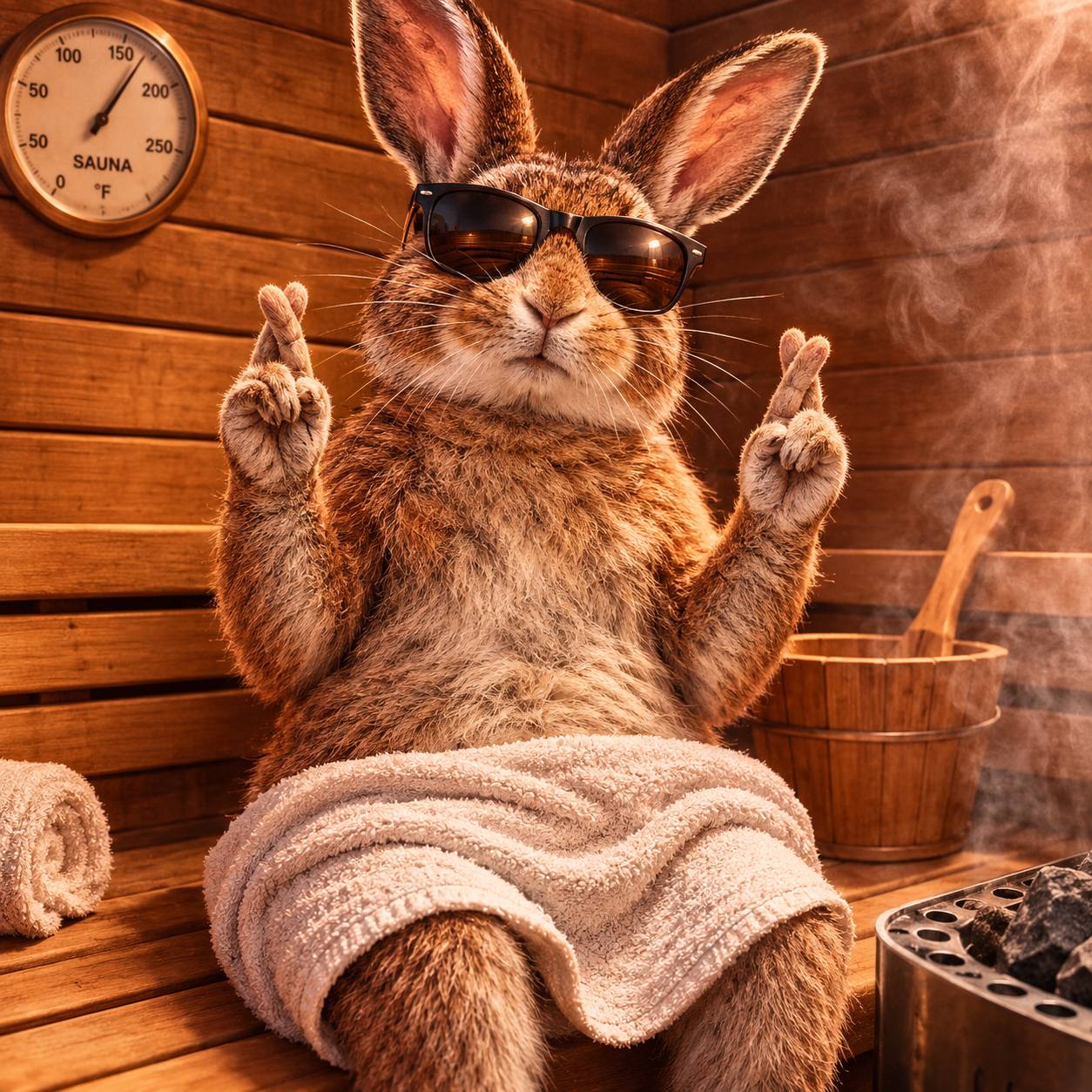
Every week the same crew — we call ourselves The Rabbit Hole — meets to sit in a very hot room and then get into very cold water, on purpose. And every week the same arguments: is 205°F better than 185°F or just louder? Does minute 25 do anything minute 20 didn't? How much water did we actually just sweat out? And after one memorable löyly pour at 190°F left my fingers stinging for a solid second — what temperature of what, exactly, causes damage?
These turn out to be great data questions. The sauna literature is unusually good (Finland has been running the experiment on itself for centuries, and cohort studies followed thousands of Finns for decades), the physiology of sweat is measurable in your own garage, and the burn-threshold data goes back to a classic 1947 dataset that still underpins scald-safety standards. So: down the rabbithole. Everything below is interactive — the models are stylized composites anchored to published ranges, so treat them as directionally right, not a prescription.
The baseline: what "normal" looks like
Before the sliders, the anchor points. The big Finnish cohort work (Laukkanen and colleagues, ~2,300 men followed for 20+ years) found the strongest cardiovascular and all-cause mortality associations at 4–7 sessions per week, with sessions around 19 minutes in traditional saunas running 174°F and up. For cold water, the most-cited protocol (Søeberg's brown-fat work) lands on about 11 minutes per week total, split across 2–4 plunges.
Benefits stack up on the hot side: heart-rate elevation comparable to moderate cardio, blood-pressure reductions, heat-shock protein expression, better sleep, and the cohort-level mortality signal. Risks stack up too, and they're mostly about dose: dehydration, dizziness and fainting (blood pressure drops when you stand), and — at the extreme — hyperthermia. The world sauna championships were literally discontinued in 2010 after a fatality at 230°F. Dose is temperature × time × humidity, which is exactly what the next section lets you play with.
The session lab
Three controls — temperature, time, and humidity — drive everything in this section: the readout tiles, the benefit/risk curves, and your marker on the sweet-spot map below. Löyly (throwing water on the stones) matters because humid heat transfers into you much faster than dry heat: same thermometer reading, bigger dose.
View as table
The sweet spot, in two dimensions
The argument we actually have on the bench is never "what's the best temperature" — it's temperature and time together. This map settles it, sort of. Each cell is net score (benefit minus risk) for that combination at löyly humidity. Blue is worth doing; red means the risk curve has eaten the benefit curve. The ★ is the model's peak; the outlined cell tracks your sliders.
View as table
The other half: cold
The plunge has its own curve pair. Benefits (the norepinephrine spike — 2–3× baseline, the dopamine lift that outlasts the dip, brown-fat activation, the mood effect) arrive fast and saturate: most of the payoff is in the first 2–3 minutes. Risks are front-loaded differently — cold shock (the gasp reflex, the reason you never plunge alone or jump into open water) hits in the first 30–60 seconds, and below ~45°F the hypothermia clock starts running in minutes, not tens of minutes.
View as table
Sweat economics: what actually leaves your body
A typical session costs 0.3–1.0 liters of water — heavy sweaters at high heat can pass 1.5 L/hour. And it's not just water: sweat carries roughly 0.9 g of sodium per liter (huge individual range: 0.5–1.5 g), plus smaller amounts of potassium, calcium, and magnesium. That's why a big sauna day plus plain water can leave you feeling flat — you replaced the volume but not the salt.
View as table
🐇 The Rabbit Hole experiment: measure your own sweat loss
Here's the fun part — you don't have to trust my curves. Whole-body sweat loss is one of the few physiology measurements you can make at home to lab-adjacent quality, because a liter of sweat weighs exactly a kilogram. Our crew is running this as a weekly leaderboard; steal the protocol.
Weigh-in / weigh-out
Gold standardNude weight on the same scale before and after, on a hard floor, after toweling completely dry. Every gram lost is sweat (plus a rounding error of breath moisture). 1 kg lost = 1 L of sweat; 1 lb ≈ 0.45 L. Use a scale with 0.1 lb / 50 g resolution and this is genuinely defensible — it's how sports-science labs do field measurements.
Corrections that make it rigorous: add back anything you drank mid-session (see Method 2), subtract any bathroom trips, and empty your bladder before the first weigh-in so it can't ambush the second.
Weigh the bottle, not your memory
The intake fixThe weak point of Method 1 is "how much did you drink in there?" Don't estimate — weigh your water bottle on a kitchen scale before and after. Bottle-loss in grams is exactly the milliliters you drank. sweat = (body before − body after) + drank. This one correction is the difference between a party trick and a measurement.
The towel audit
Cross-checkPre-weigh a dry towel sealed in a zip-lock bag. After the session, wipe yourself down completely, seal the towel back in the bag (so nothing evaporates on the way to the scale), and re-weigh. This captures the sweat still on your skin — the fraction that dripped and clung rather than evaporated. Run it alongside Method 1 and you can split your loss into evaporated (which actually cooled you) vs dripped (which just left).
The waterproof pan
Lower boundThe classic garage-science move: sit or rest your feet over a tared waterproof tray and weigh what drips into it. It only catches drip — evaporated sweat escapes it entirely — so it's a strict lower bound, not a total. But it's visceral, it's hilarious for a leaderboard, and paired with Method 1 it tells you what share of your sweat is doing useful evaporative cooling versus pooling on the bench.
Urine check
Status, not volumeUrine specific-gravity strips (a few dollars) or the humble color chart, before the session and the next morning. This doesn't measure the session's loss — it measures whether you actually rehydrated afterward, which is the number that matters by Tuesday. Semi-quantitative, but it keeps the whole experiment honest: a dark-morning-urine streak means your replacement protocol is losing.
The burn question (or: why did my fingers hurt at 190°F?)
The origin story: I was standing with my hands near the ceiling when someone poured water on the stones at 190°F. The steam cloud hit my fingers and they hurt — sharply, for about a second — with zero damage. Meanwhile I'd been sitting in 190°F air for fifteen minutes, completely comfortable. Same thermometer. Wildly different experience. Why?
Heat transfer, not temperature, is what burns you. Dry air is a terrible conductor and your sweat layer is actively evaporating, so 190°F air delivers heat slowly enough that your skin sits far below air temperature. Water is ~25× more conductive — and steam is the nastiest of all, because when it condenses on your skin it dumps its latent heat of vaporization: about 2,260 joules per gram, on top of the hot-water heat. A löyly cloud is a burst of condensing steam: enormous instantaneous heat flux, but lasting a fraction of a second — enough to fire every pain nerve, not enough total energy to injure. My fingers filed an accurate report.
View as table
Read the gap between the lines at 140°F: water at that temperature injures skin in about 5 seconds; a metal bench takes ~10; dry air at 140°F is a mild sauna you could sit in for an hour. This is also why your buddy's doctor is right that steam sterilizes: hospitals autoclave instruments in pressurized steam at 250°F for 15–20 minutes precisely because condensing steam delivers heat so brutally efficiently that it kills even bacterial spores. The löyly that stung my fingers and the machine that sterilizes a scalpel are the same physics at different doses.
The thermometer tells you the temperature of the room. The physics that matters is how fast the room can get that temperature into you — and water, in any form, is the express lane.
Know your hot rooms
Last stop in the rabbithole: not all hot boxes are the same experiment. Same "sauna" label, five different heat-delivery mechanisms — which, as established above, means five different doses at the same nominal comfort level.
The one in the cohort studies. Wood-lined, stove-and-stones, sharp dry heat. Sweat evaporates instantly, so it feels less brutal than the number suggests. Nearly all the longevity evidence lives here.
The Finnish sauna's turbo button. Each pour sends a condensing-steam wave that momentarily multiplies heat delivery — the "same temp, way hotter" effect. This is the dial our crew actually argues about.
Feels ferocious at barely half the Finnish temperature — at 100% humidity your sweat can't evaporate, so you lose your main cooling channel. Gentler on airways for some; the cardiovascular evidence base is thinner.
Radiant panels heat you directly instead of heating the air. Lower air temperature, longer sessions, easier entry point. You still sweat plenty; whether it replicates the Finnish outcome data is genuinely unsettled.
The heritage version: a chimney-less room fired for hours, smoke vented, then entered on stored heat. Finns describe the löyly as the softest there is. The single-batch sourdough of saunas.
Hotter-humid middle ground, plus percussive massage with leafy birch bundles (venik) that drives hot air onto the skin — mechanical löyly. Culturally inseparable from the cold dunk between rounds.
This is a data essay, not medical advice. The curves are stylized models anchored to published ranges — real physiology varies person to person, and several groups should be conservative or abstain entirely: anyone with cardiovascular conditions (talk to your doctor — though supervised sauna is used in cardiac rehab), pregnant people, kids, and anyone under the influence. Alcohol + sauna is the single biggest documented risk factor in Finnish sauna fatalities. Never plunge alone, never plunge into open water without exit help, and exit anything the moment you feel dizzy.
Sources behind the anchors: the Kuopio Ischaemic Heart Disease cohort (Laukkanen et al., JAMA Internal Medicine 2015) for sauna frequency and mortality; Søeberg et al. (Cell Reports Medicine 2021) for the ~11 min/week cold protocol; Moritz & Henriques (1947) for scald thresholds; ASTM C1055 for surface-contact limits; standard sports-science sweat-testing protocols for the experiment section.
Run the experiment, report back
If you weigh in and out this week — you and your crew — I want the numbers. The Rabbit Hole's running leaderboard says our biggest sweater clears a full liter in 25 minutes at 195°F. Beat it (safely, with a water bottle on the kitchen scale).